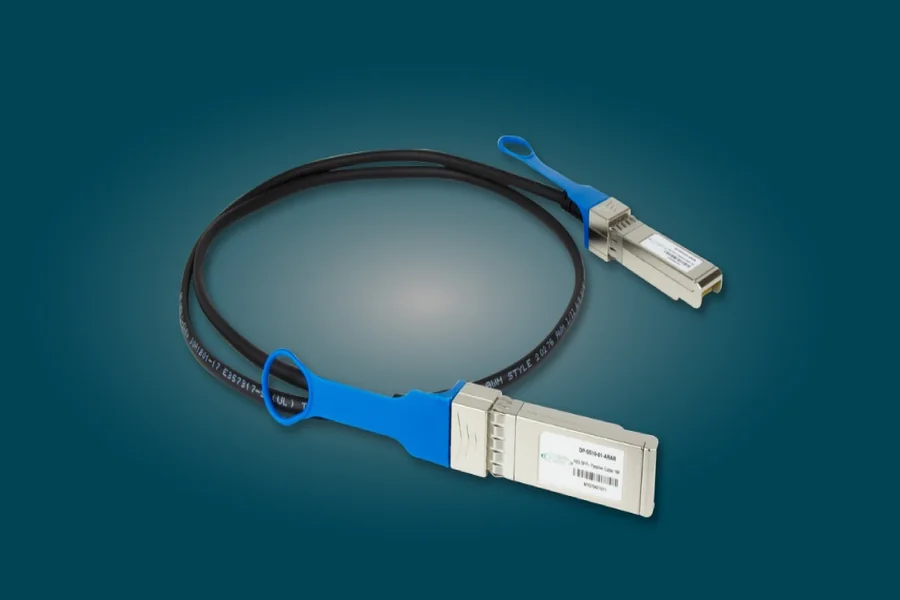
An 800G DAC cable, short for Direct Attach Copper cable, is a high-speed passive or active copper interconnect designed to support data rates of up to 800 gigabits per second. It is widely used for short-reach connections within data centers, particularly for switch-to-switch and switch-to-server links where low latency, low power consumption, and cost efficiency are critical.
Unlike optical transceivers, 800G DAC cables integrate the cable assembly and connectors into a single unit, eliminating the need for separate optical modules and fiber. The electrical signals are transmitted directly over copper conductors, typically using eight high-speed lanes operating at 100 Gbps per lane with PAM4 modulation. Due to their simplicity and direct electrical interface, DAC cables introduce minimal latency and reduce system complexity.
800G DAC solutions are commonly available with OSFP or QSFP-DD connectors and are optimized for short distances, usually ranging from 0.5 meters to 3 meters for passive DAC and up to 5 meters or more for active DAC. These characteristics make them ideal for high-density, short-reach interconnects inside racks or between adjacent racks.
Key Features and Technical Characteristics of 800G DAC Cables
One of the most significant advantages of 800G DAC cables is their low power consumption. Passive DAC cables consume virtually no power, while active DAC cables use minimal power compared to optical solutions. This makes them highly attractive in large-scale deployments where power efficiency directly impacts operational costs and thermal design.
Signal integrity is another important technical consideration. At 800G speeds, maintaining clean electrical signals over copper is challenging. High-quality 800G DAC cables use carefully designed twinax copper structures, advanced shielding, and precision manufacturing to minimize crosstalk, attenuation, and electromagnetic interference. Active DAC variants further improve signal quality by integrating retimers or equalization circuits within the connector housing.
From a mechanical and operational perspective, 800G DAC cables are plug-and-play and hot-pluggable, allowing for fast installation and replacement without disrupting network operations. They also support standard management and identification features, enabling switches to recognize cable type, length, and performance characteristics automatically. This simplifies inventory management and reduces configuration errors in complex data center environments.
In addition, DAC cables are known for their cost advantage. Compared with optical transceivers and fiber cables, 800G DAC solutions typically offer a significantly lower total cost of ownership for short-reach links. This cost efficiency becomes increasingly important as port speeds and port counts continue to scale upward.
Typical Applications and Deployment Scenarios
800G DAC cables are primarily used in hyperscale and enterprise data centers for short-distance, high-bandwidth connections. A common deployment scenario is inside a single rack, connecting top-of-rack switches to servers or accelerators. In such environments, DAC cables provide sufficient reach while delivering the lowest possible latency and power consumption.
Another major application area is switch-to-switch connectivity within leaf-spine architectures. For adjacent switches or tightly coupled network tiers, 800G DAC cables enable high-speed interconnects without the added cost and complexity of optical solutions. This is particularly beneficial in dense network designs where hundreds or thousands of high-speed links are required.
Artificial intelligence and high-performance computing clusters also rely heavily on 800G DAC technology. AI training workloads generate massive east-west traffic between GPUs and compute nodes, often within the same rack or row. The low latency and high reliability of DAC cables help ensure that compute resources remain fully utilized, which is critical for large-scale AI model training and inference.
While DAC cables are not suitable for long-distance transmission, they play a complementary role alongside optical interconnects. Many modern data centers adopt a hybrid approach, using DAC cables for short-reach connections and optical modules for longer links. This balanced strategy allows operators to optimize performance, cost, and energy efficiency across the entire network.
Overall, the 800G DAC cable is a practical and cost-effective solution for short-reach, ultra-high-speed connectivity. Its combination of simplicity, reliability, and efficiency makes it an essential component in next-generation data center and AI networking infrastructures.